Showing posts with label Westmoreland County Coke Ovens. Show all posts

Sunday, November 12, 2023

Derry No. 2 Mine and Coke Works/Red Shaft

  Almost ten years to the day, and I finally got a chance to explore the Derry No.2/ Red Shaft Coke Works. The last time I posted anything about these ovens was November 30, 2013. I guess good things come to those who wait. Recently I was offered an opportunity to get out here and I just couldn't pass it up. Unfortunately, these ovens are most likely all going to be removed. However, a few of them might remain. There are a handful that remain intact, the rest are in varying states of decay. The intact ovens with the retaining walls and fronts do have a chance of being kept for posterity. All of this is undecided and only time will tell. Let's hope for the best. 


Overall, it is an interesting site, as they all are. These ovens really didn't have a long lifespan. Constructed by Derry Coal and Coke Company, Derry No. 2 first appeared as a new mine in the 1903 reports as "a new shaft opening into the Pittsburgh Seam and was in favorable condition. The ventilation was produced by radiation by steam. A ventilation fan was in course of erection and almost completed; this when in operation will greatly improve the ventilation". It is listed as having a total of 15 employees (inside and outside) for this year. This is also one of those "off years" on the mining reports that only list the number of ovens by the company, rather than the individual mines. Derry No. 1 would always be the flagship of the two, and there are 274 ovens listed for that year. 


In 1904 we still have 274 ovens at both of the mines combined. Derry No.2's "condition was favorable. The ventilation has been improved by the erection of a ventilating fan of the Guibal type, size 20x6 feet. This mine has recently been connected with the Derry mine by a pair of entries." The last sentence already hints at this coke works impending demise. 


1905 gives us more insight. Derry No. 2 is listed as having 50 ovens, and Derry No. 1 is listed with 224. So that clears up the last two years. There would never be more ovens added to Derry No. 2 than the original 50. Derry No. 1 would continue to expand. Derry No. 2 was simply listed as "in good condition" that year. More importantly is the new ownership by the Latrobe-Connellsville Coal and Coke Company....


Mathias Saxman was one of the who's who of this portion of Westmoreland County. His great grandfather, Christopher Saxman, emigrated from Wittenberg, Germany in 1764. He settled along the Loyalhanna Creek near present day Latrobe, where he operated one of the earliest flour mills in this region. Mathias (born November 22, 1836), named after is grandfather, Christopher's son, was the only child of Peter and Barbara (Butt) Saxman. He was a farmer until he was 35 years old, at which time he started purchasing coal lands in the Latrobe and Derry areas. He first organized the Saxman Coal and Coke Company, followed by the Derry Coal and Coke Company. He controlled these companies for 18 years. He then organized the Superior Coal and Coke Company with the Hon. George F. Huff (well known for his Greensburg coal companies as well as his namesake Hufftown, South Greensburg) and the Latrobe-Connellsville Coal and Coke Company. In June 1905, all of these companies were brought under one umbrella and became Latrobe-Connellsville Coal and Coke Company. (This is a very rough sketch of Mathias Saxman and there is a much more detailed biography written in "History of Westmoreland County Pennsylvania - Genealogical Memoirs - Vol. III - John W. Jordan, LL.D., 1906")


Cabinet photo of Mathias Saxman, I purchased earlier this year at the Miller's Crossing Fleatique in Irwin.


Death Certificate courtesy of Find a Grave.com

1906 found Derry No. 2 "In good condition as to ventilation and drainage". The mine and coke works employed 125 men, worked 290 days, mined 75,423 tons of coal, and produced 6,813 tons of coke. The percentage of coke to coal already shows us that they weren't paying much attention to these ovens. 


1907. Derry No. 2 "where the drainage still required improvement", produced 114,075 tons of coal and 10,719 tons of coke. 114 employees worked 282 days that year. Derry No. 1 had increased their ovens to 293 this year. 1907 would be the last year that we saw any recorded coke production at Derry No. 2. 


In 1908, 127 employees worked 24 days mining 10,670 tons of coal. 


1909. Derry No. 2 is down to 4 employees. They produced 1,170 tons of coal. 1,111 tons were used at the mine for steam and heat. The remaining 59 tons were sold to local trade or were used by the employees. The mine was listed as idle.


1910,1911. Idle the entire year.


1912,1913- Idle except for pumping and ventilation. 


1914- Not even mentioned


Derry No. 2 is mentioned one last time in 1917 and confirms that it was still being used for drainage and ventilation purposes. Under the "Improvements" section of the second district mining reports, Latrobe-Connellsville Coal and Coke "built new headframe, and installed a Robinson fan at No. 2 air and pumping shaft".


That would appear to be the end of Derry No. 2. A handful of these ovens were probably used privately at a later period. The few that remain intact also show signs of later alterations. Rough patchwork, concrete block, and other materials not original to the site can be seen in a couple places. It was normal at lot of these sites for locals to fire up a couple ovens after they were abandoned by the coal companies. Toward the end of the coal and coke era much of this land was stripped. This provided the area with an abundance of locally produced coal for the next generation or two. A truckload of coal could be purchased from any of these strip mines and dumped right into the ovens. My Grandfather wrote in his memoirs about doing this himself at old coke works near Mt. Pleasant. 


Derry No. 2 shown on a portion of a map of the coal lands belonging to Latrobe-Connellsville Coal and Coke.

Derry No. 2, although small, did contain a few company houses for the workers. The houses were located in a field southeast of the ovens. The houses are shown on this map on land owned by Joseph Guthrie. 

This is supposedly a photo of Derry No. 2. I'm skeptical on the accuracy of this. The layout on this photo seems off from what the map and the site itself suggest. The few remaining pieces of the old construction we located were found in front of these ovens. This photo puts everything behind the ovens. 


Here's what's left today:


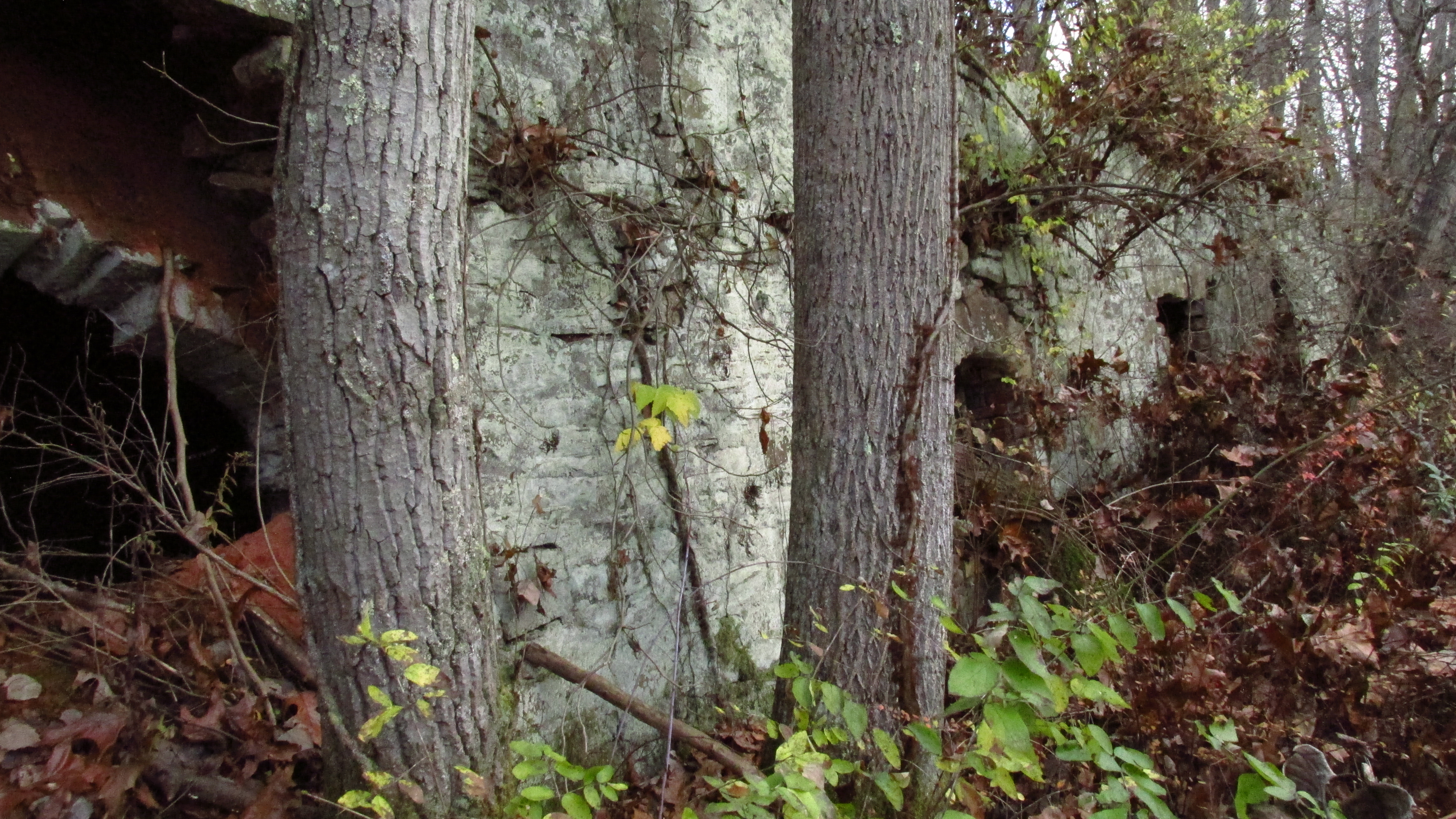
The more intact ovens on the eastern end of the bank.


The running theory on these piers is that they held a water tank to quench the coke. 


Some of the more deteriorated ovens.


Inside of one of the ovens.

At least two of these ovens were connected in the bottom. I don't understand the reason for this.


The eastern end of the oven bank. 

Some of the hardware that I believe held the hoist for the shaft.


Corner wall of the hoist house, fan house, boiler house, whatever this building was. The couple maps we have are not very descriptive. 

Opposite corner wall.

Haulage spur off of the Bradenville Branch of the Pennsylvania Railroad.

Closeup of the "connector" between the two ovens.

Main line of the Bradenville Branch of the Pennsylvania Railroad


Field where the company houses were located. Former site of the Red Shaft patch.


Saturday, March 9, 2019

Virgie Coke Works

A year or two ago, a friend of mine messaged me about some coke ovens he had seen across from the Madison Country Club. I checked the location on the map and just assumed they were part of the Upper Whyel, Yukon Coke Works. I covered that area six years ago and thought I got it all. Fast forward to a couple weeks ago when Lou came across a previously unavailable map, which clearly marked this area as two separate coke works. One was listed as the Whyel Coke Company's ovens and the other was listed as the Byrne Coal and Coke Company's ovens. This indicated that we had finally located the elusive Virgie Coke Works! We were all long aware that Virgie existed near Madison but we could never place it. This long lost map gave us the missing piece. It was extremely easy to misidentify. The end of the Yukon ovens and the beginning of the Virgie ovens are, at most, fifty feet apart. It was always assumed that both sets of ovens were part of Whyel. 


Today started with the counting of ovens. Counting coke ovens is my version of Hell on Earth. I hate it. Absolutely despise it. Trying to keep track of the count while cutting your way through jaggers, and trekking through swamps trying to keep your feet dry is too much for a mere mortal man. Turns out Lou is good at it though. I forget the count on the Yukon ovens, and looking back on that post from six years ago, it really needs redone. No dialogue whatsoever. So focusing on Virgie: We needed 42 ovens and we counted 42 ovens. We were there. 


The long lost map. Our focus today was to start at Whyel, get past the ovens, locate the tipple ruins, locate the Virgie ovens, locate the Virgie tipple ruins, and follow the railroad grade to the end. I'm proud to say we pulled it off.


The Byrne Coal and Company was organized in 1913, and the Virgie Mine and Coke Works began operations in 1914.


A 1913 announcement of the Byrne Coal and Coke Company's new charter, from the Coal and Coke Operator trade journal.


Now, this new enterprise was operated exclusively within the Byrne family. The father was John R. Byrne. He had 12 children, and was involved in an enormous amount of industry in his lifetime. The following biographic description comes from the "Book Of Prominent Pennsylvanians", published in 1913.


The man had his hands in a little bit of everything. He worked hard. Interesting is the fact that he was involved with the Connellsville Mutual Coke Company. The players in these companies always seem to run together. One of the greatest hidden historic coke works in Westmoreland County is the Love Works, that were operated by the Connellsville Mutual Coke Company. I love when pieces start falling into place.


One of John R. Byrne's sons was also featured in the book. He was a Uniontown attorney and a director in the Byrne Coal and Coke Company.


The "firm of Byrne & Byrne" would indicate that another one of the Byrne's also became an attorney.  This was a large family. I would imagine that there are descendants in the area. I would love to hear more about the Byrne's family involvement in the coal and coke industry.


Byrne Coal & Coke Company advertisement from the February 28, 1918 Connellsville Courier.


Aside from the Byrne Coal and Coke Company, there is also (listed in mining reports) a Byrne Gas Coal Company, and a James Byrne & Company as seen in this 1916 Industrial Directory.


Back to Virgie. In the Pennsylvania Mining Reports, Virgie is listed as a new mine in 1914. No coke ovens are listed for this year. In 1915, 34 ovens are listed. 1916 would also list 34 ovens, producing 23,286 tons of coke, and operating for 279 days that year. In 1917, eight more ovens were constructed at Virgie. The 42 ovens would produce 37,781 tons of coke that year. 1919 would be the last year that Virgie appeared in the mining reports. In 1919, only 9,164 tons of coke were produced in their 42 ovens. This is an indication that the mine was being worked out. In 1920, the mine is no longer listed in the mining reports, but the coke works is still listed in the Connellsville Courier's coke oven list. It would remain this way until 1924. After that, I can find no trace of the Virgie Coke Works. From 1920-1924, it is likely that the ovens were still operating but the coal was being brought in from somewhere else.  All indications at Virgie, like nearly every other coke plant in the region, suggest that these ovens were reconstructed and used by somebody much later than 1924. This is nearly impossible to find any records of, as they weren't always used legally. Occasionally, you can find mentions of small companies or individuals using these ovens in old newspapers, but I was unable to do this with Virgie. 


So this is what it looks like today:


Starting out at the Yukon ovens.


Approaching the end of the Yukon Ovens.


The end of the Yukon Coke Works.

Immediately after the ovens we located the ruins of the tipple we were looking for. There is a much clearer photo a little further down. Bear with me.


Climbing up over the hill, searching for the Yukon Mine's drift entrance, we saw several of these old water tanks.


More of the Yukon tipple ruins. The large concrete structure went directly to the tipple to load the larry cars with coal. These smaller "steps" led directly to the slate dump.


More of the slate dump side of the tipple.


Brother Lou's leg and another tipple pier.


This massive concrete structure was part of the main tipple.


Looking over at the Yukon Mine's slate dump.


Looking up the Whyel Branch of the Pennsylvania Railroad. Heading to Virgie Coke Works.


About 50 feet up the old grade, we approached the corner of the Virgie coke yard.


The beginning of the Virgie Coke Works.


Immediately it is noticeable that these ovens have been greatly altered.  Concrete block was not traditionally used in beehive coke oven construction.


This whole area was a viney mess.


Some ovens that are still in decent condition.


The dome of this oven had a seriously distorted wave. The firebrick appears to be in excellent condition though.


The door arch of this oven is intact now, but in another year or two it's going to be on the ground.


More evidence of later modifications.


Fascinating brick arch work.


Trees hate coke ovens.


Somebody was using these after 1924.


The front is still nice on this oven but the oven itself has collapsed.


Looking over at the Virgie slate dump.


Lou holding one of the golf balls that he found. Apparently they get whacked the whole way over here from the golf club.


The wall of this oven has completely collapsed.


Down in the clearing. This is the area of the ovens that are visible from Yukon Road.


This wall remains but everything around it has collapsed.


Some of the more deteriorated ovens.


Piers from the Virgie tipple on the other side of the stream.


More of the Virgie tipple structure.


Up above the coke works, we found this small impounded reservoir. It was most likely used to quench the coke at the Virgie Coke Works.


Ruins of the old stone dam.


Looking down at the ovens from the slate dump.


Virgie Mine slate dump. From Yukon Road, you only see the top of the mine dump. It looks small. The backside of it is absolutely massive. For it's small lifespan, Virgie Mine removed a lot of material from under the ground.


Looking down the dump into the valley.


Leaving this area. Bloody from jaggers and thorns, muddy as anything, with wet feet, we came across a nice piece of Pennsylvania Railroad track still intact.