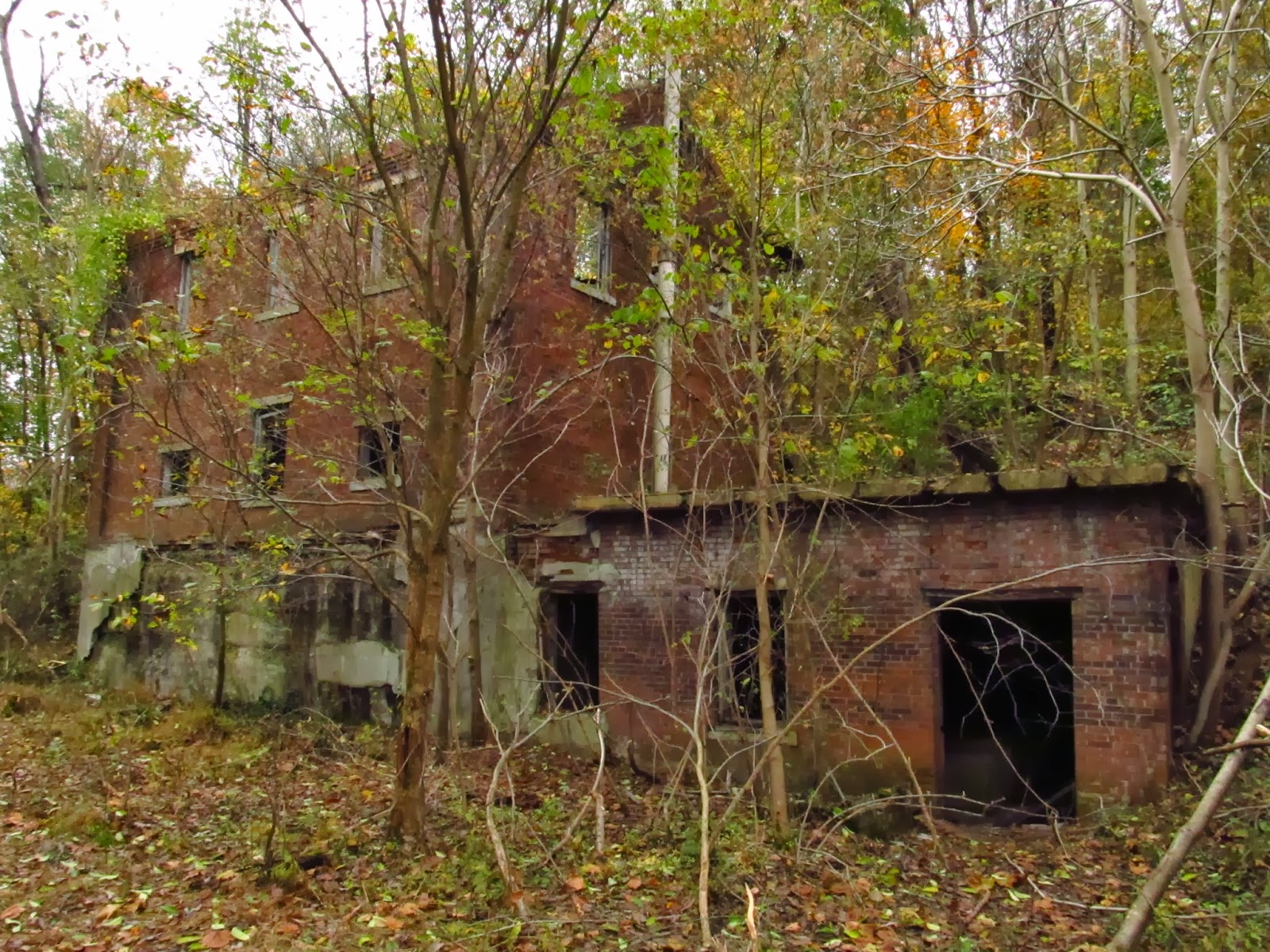
Today I had an opportunity to check out some of the harder to find rectangular coke ovens. These ovens are in a really interesting, isolated area but easily accessible. The road they are off of ends at a closed bridge that will probably never be opened. The chances of just stumbling across them are pretty low. The ovens are in pretty good shape and the area is not too overgrown. Just perfect.
The Katherine Coke Works date back to 1909 and were constructed by the Union Connellsville Coke Company. The mine was a 176 feet deep shaft mine and the coal field was 160 acres. 75 ovens were completed by November 1909 and 65 more were being constructed. The plant would remain at 140 ovens throughout most of its existence. On May 13, 1927 Katherine was purchased by the W.J. Rainey Co. at which time the plant is listed as having 150 ovens. It also states that the "plant has not been in operation for some time". The ovens were constructed by contractor W.H. Wilkey of Uniontown throughout 1909. Mr. Wilkey was a busy man at this time because he had just recently opened up his own coke plant, Anica Coke Works.
On Sunday November 14, 1920 at 10:20 PM a fire broke out at the top of the wooden tipple. An alarm was sounded but before anything could be done the massive structure and 300 ton coal bin were completely engulfed. After the tipple collapsed the burning coal fell down the shaft setting the shaft timbers on fire. The timbers at the bottom of the shaft were burned up from 100 feet to the bottom. All four sides of the shaft collapsed as well as the roof of the main entry. The shaft cage fell to the bottom and melted. Nobody was in the mine at the time so the fans were shut off and the openings sealed to try and put the fire out. The temperature at the bottom ranged from 2,500 to 3,000 degrees and fused the mine rails, car irons, pump casings and everything else that could melt. The coal seam was cooked from two to five feet at the location of the fire. They decided to seal the mine to control the fire instead of using water which would have required more water than they could obtain. Also flooding the mine would jeopardize the numerous other mines laying next to this mine.
The seals were left in place for six weeks and a pipe was installed in the top seal to gather temperature and pressure readings to determine the condition of the mine. After six weeks the readings were between 85 and 86 degrees. The seals were broken and the fans turned on to clear the gasses. An exploratory team was sent into the mine through an air shaft where they found no blazing fire but some hot falls. They lowered a hose down the shaft and fought the hot spots effectively putting out the remainder of the fire. The mine was declared non gaseous and a temporary tipple was built over the air shaft which was used as a hoisting shaft. They then began cleaning out the mine. Work was slow and was carried out in three 8 hour shifts. Eventually the mine was rebuilt and cleaned and coal mining was started again.
The damage was estimated at $250,000.00
I haven't been able to find anything on when Katherine was shut down for good. The last mention I found was Rainey purchasing it in 1927. Today most of the 140 ovens exist in some form but the eastern end of the block seems to be missing an oven or two.
 |
| Coke drawing machine and larry car at Katherine ca. 1920. |
 |
| Machine crew at Katherine shaft ca. 1920. |
 |
| Swinging bridge across Dunlap Creek leading to Katherine shaft ca. 1920 |
 |
| The temporary head frame they constructed over the air shaft to clean out the mine and fight the fire in 1920. These photos are from the "Coal Trade Bulletin" of June 1, 1921. |
 |
| A view of the ovens from across the creek. |
 |
| The old closed bridge you have to cross to get to the ovens. |
 |
| An old abutment coming off the Monongahela Railroad ROW. The embankment on the other side is at the very bottom of this post taken while we were walking to Dunlap. |
 |
| The closed bridge. No idea why it's closed. Looks sturdy to me. |
 |
| The ovens! |
 |
| These rectangular, or Belgian, ovens were larger than beehive ovens. They were charged the same way, through the top trunnel hole, but when the coke was pulled it was simply pushed through one end to the other. |
 |
| They're in really good shape sitting in this isolated location. The front's are not buried but there are a couple seasons worth of leaves piled up in front of them. |


 |
| A look from inside the ovens. |

 |
| The construction of Belgian ovens is incredible. When these ovens are completely intact there are so many varieties of stone and block. They truly are art. |
 |
| This is an example of a very well weathered Belgian oven. Also taken during this trip. This oven is at Allison. |
 |
| Like I said, the area these ovens are located make for a very nice walk. |


 |
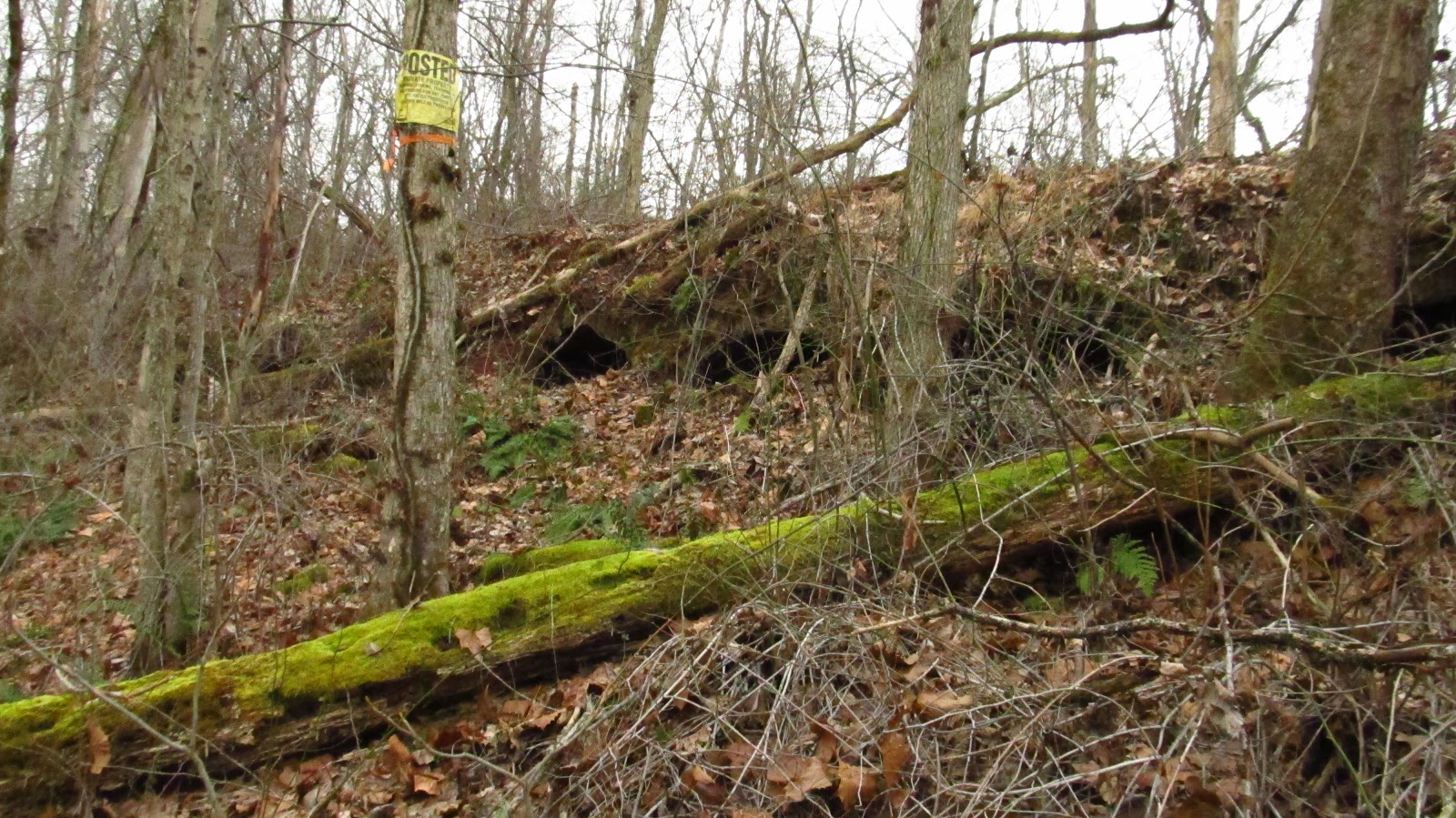
| This block is very long. The other end starts to get a little grown in and about halfway down the block the area is posted against trespassing. |


 |
| A piece of block from the original front of these ovens. There should have been a lot more of these laying around. They were probably used somewhere else. |



 |
| This is the far end of the block. The last couple ovens seem to be missing but overall this is a great site. |
 |
| On top of the ovens. These trunnel holes are much larger than beehives. |
 |
| An ash dump for the ovens. |
 |
| A couple views of the ovens from the ash dump. |


 |
| As you can see, this block is pretty extensive. |


 |
| The intact end of the block. |
 |
| And the other abutment along Dunlap Creek. |