Showing posts with label Alverton PA. Show all posts

Tuesday, December 19, 2017

Mayfield (Alverton No. 2) and Carolyn/Peerless Coke Works

Today was a nice, sunny break in the weather and I was also off work. Bonus! I headed over to Alverton to explore a couple more difficult to get to coke plants. Alverton is a historically rich area as far as coal and coke production. We've found ourselves here a good many times over the past few years. 


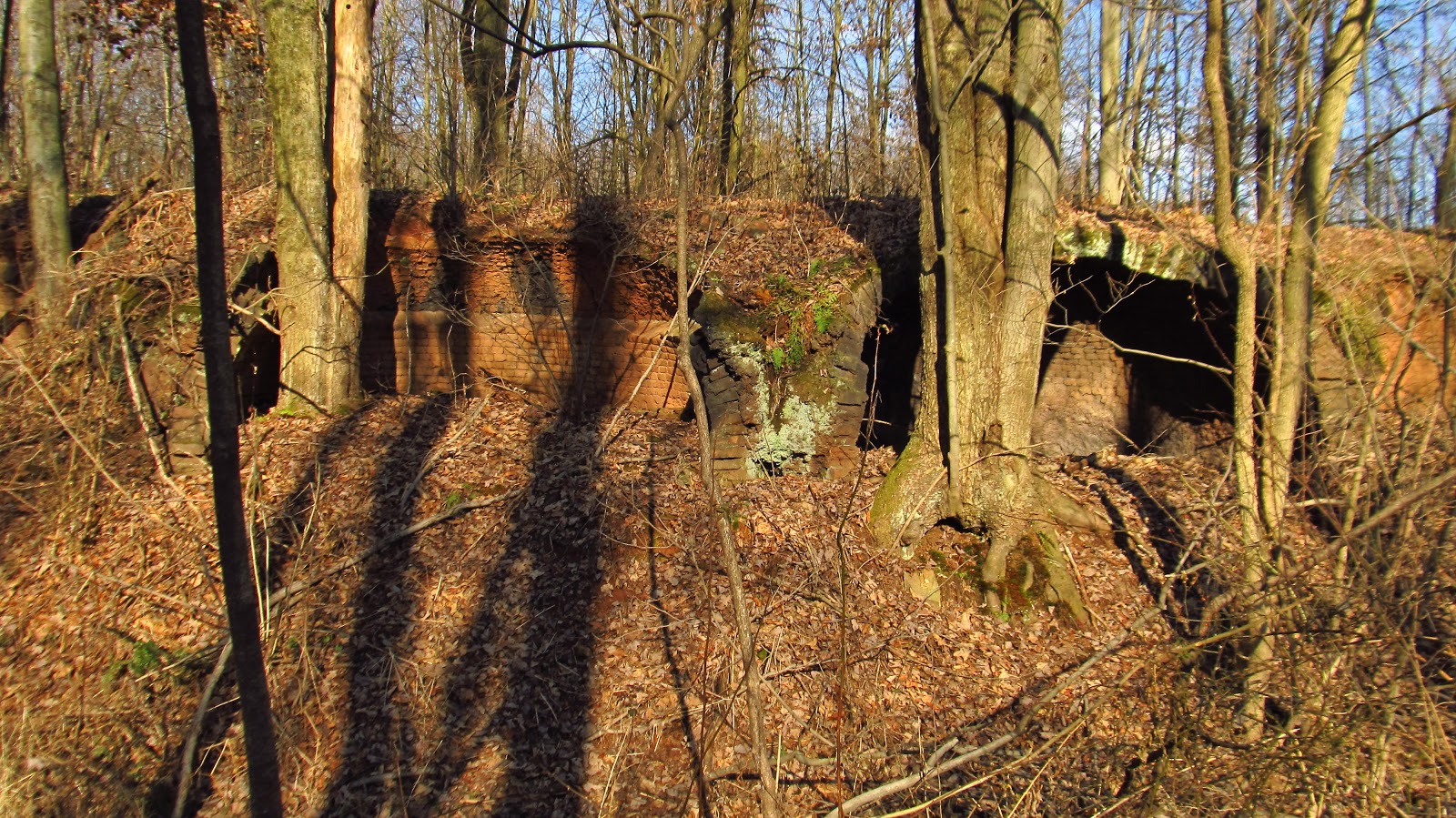
These two coke plants are both in really bad condition with only a fraction of the ovens remaining. Mayfield (Alverton No. 2) is a very old coke plant dating back to ca. 1878. It was a McClure plant and was renamed Alverton No. 2 in 1899. It contained 55 ovens up until 1890 and after that is listed as having 104. We know that Frick absorbed McClure in 1895 so after this, it kept the name McClure but must have been controlled by Frick. It is not listed as a Frick plant until 1901. I am also finding no mentions of  Alverton No. 2 after 1920. 


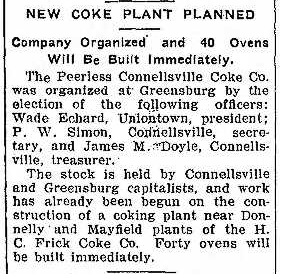
Carolyn/Peerless Coke Works on the other hand, is a later coke plant. The Peerless Connellsville Coke Company was organized in 1907 with Wade Echard as President, James M. Doyle - Treasurer and P.W. Simon - Secretary. Others named in the charter include George Wilson, Christian Echard, John M. Mumaw, Samuel Cummings, J.M. Kennel, and Cyrus Echard. Their small coke plant of 32 ovens was named Carolyn and fired in the spring of 1908. I can't find how long they operated the plant under this name. By 1920 the plant was renamed Peerless and was being operated by the Mahoning Coal and Coke Company. After that I lost track of this as well.


Portion of the Alverton No. 2 mine map showing the Mayfield and Carolyn Coke Works. Mayfield, I believe originally started at the bottom and eventually started working its way north. Carolyn never got any bigger. Coincidentally, all that's left of Mayview today is the original part.


Mine map superimposed over a road map. Alverton No. 2 ran along a large portion of Sportsmen Road and ended up almost butting up with Donnelley Coke Works to the north.


Mine map superimposed over a modern aerial view.


This 1939 aerial shows that these two coke plants were still intact but very much abandoned.


Mayfield/Alverton No. 2


These are very old and in very bad condition.


This is probably the best one left.


The old rail bed that headed up to Carolyn after leaving here.


All the ovens at Mayfield were bank ovens.


These two are of the backside of the bank.


This is where the ovens just disappear.


Carolyn/Peerless


There are only five ovens left here.


What remains are in decent shape though.


There are some nice foundations and piers left.


The rail bed. You can see the bank where the rest of the ovens were to the right.


A couple footers on the ground.


Some sizable coke laying around.


One of the piers.


One of the arch blocks from the ovens.


An oven full of bones. This was a first.


Bricks that fell from the ovens.


Merry Christmas! This is my cat Skippy under the tree.


Sunday, February 5, 2017

Alverton Coke Works/Union Coke Works

Just south of Alverton are the ruins of some more modern "smokeless"coke ovens. The site itself was the location of one the earlier coke plants. Union Coke Works was constructed around 1873 and was operated by Hurst, Stoner & Company. On June 11, 1872 the property, about 51 acres, was purchased from Peter L. Shupe by Braden Hurst, B.B. Stoner, W.B. Neel and Mr. Schall (or Shaw, some reports vary from Schall and Shaw). 30 beehive bank and 40 beehive block ovens were constructed. In 1875 Schall conveyed his interests in the company to the other three and parted ways. When the land was purchased from Shupe, Shupe retained a one fourth undivided interest in the coal. Under this contract 28 ovens were built on the original tract purchased by the company and the other 42 were built on the Shupe tract. The tipple was erected on the Shupe tract and the mine opening was located on the line between the properties. This business was conducted as the Union Coke Works. Shupe was to receive one seventh of the net profits and the other six was divided among the other parties. The business operated in this manner until 1878 when Shupe leased his undivided interest to William J. Rainey. On January 1, 1880 Rainey purchased Shupe's interests outright. On January 15, 1880 Gilbert T. Rafferty and Charles L. Donnelly purchased one half of Hurst, Stoner and Neel's interest. It remained this way until September 30, 1895 with the net profits being divided into seven separate parts. Three shares being paid to Rafferty and Donnelly, one share each to Stoner, Hurst and Neel, and one share in a separate account, first in the hands of Rafferty and Donnelly, then McClure and Company and finally the McClure Coke Company. Rafferty and Donnelly operated the plant until June 1888 when the McClure Coke Company took over. McClure operated the works until October 1, 1895. McClure sold all his interests to the H.C. Frick Coke Co. that same year and Frick and Rainey operated the plant jointly until 1901. In 1901 W.J. Rainey is listed as owning the plant again although he kept his shares throughout the whole process. In 1920 the Alverton Coal and Coke Co. is listed as the operators. 


These ovens would be operated by one firm or another until the 1970's when Oliver K. Painter constructed the MacDonald smokeless ovens. Eight of these ovens were constructed by 1977 and lasted six years until the DEP pulled the plug. Apparently the smokeless ovens weren't smokeless enough. Alverton was allowed to burn one beehive oven as a demonstration at its annual coke festival. 1982 was the last year that was permitted. After this there has been no more coke made in beehive ovens (legally) in the United States. 


Today there are no more beehive ovens left at Union Coke Works.  All that remain are the ruins of the smokeless ovens. They're interesting but they aren't the coke ovens we're used to. 


A photo of the smokeless ovens when they were recently abandoned. They don't look like this anymore. Also note the remaining beehives to the right of the ovens. Those are gone now. The smokeless ovens have two holes in the top. One for charging and one for the chimney structure.

 
A view from the top of the smokeless ovens. It looks like it was two ovens per chimney. These photos are courtesy of the Library of Congress.


Alverton was once Stonersville. At the bottom right corner of the map you can see the Hurst, Stoner and Co. coal bank. This is the location of Union Coke Works. At the top left you can see the American Coke Works, operated by Samuel Warden which Mary Jane and I covered last spring.


Big empty field above the ovens. Probably where the original block of beehive ovens were located.


Side of the smokeless ovens.


Crumbled ruins of one of the smokeless ovens.


They are different. Pretty cool though.


These are not beehive ovens. They are similar to the Belgian rectangular ovens in a way. The interior is flat and not arched in the middle like the rectangular ovens and there is a wall in the back. They are probably the same length as rectangular ovens.


Two holes in the top. One for charging and one for the chimney.


An interesting feature on the outside. Not sure what is was used for.


Basic trunnel hole.


A bunch of Woodland bricks. Cool but who wants bricks from the 70's?


More intact trunnel hole.


These ovens had to have come with a pretty decent sized price tag.


These blocks are pretty interesting though.


The prize! The top of an old larry car that was used for charging the ovens. Probably dating from the beehive years.


There were numerous potential mine entrances throughout this site. This is one of them.


This is another.


Numerous subsidence holes.


Another potential mine entrance. This could also be leftover from stripping operations that took place here.


And that's Alverton/Union.